
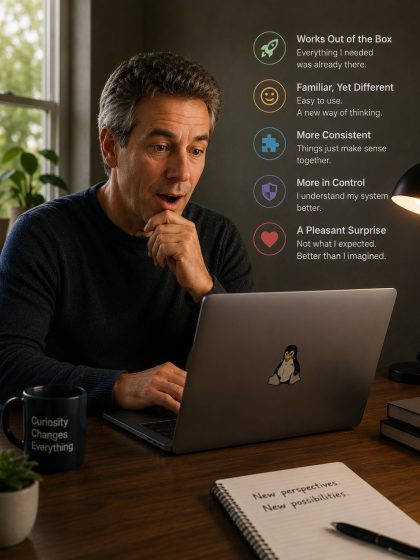
What Surprised Me Most About Linux
When I first started looking into Linux, I had a set of expectations.
Some of them were based on things I had heard over the years.
Some were just assumptions I had never really questioned.
And like most assumptions, they were only partly true.
What surprised me wasn’t that Linux was completely different.
It was that in some important ways… it wasn’t.
It felt more familiar than I expected
I didn’t expect to sit down and feel like I could actually use the system right away.
But I could.
There was a desktop.
There were menus.
There was a browser, a file manager, settings—everything I needed to do basic work.
It wasn’t identical to Windows.
But it wasn’t foreign either.
It felt like learning the layout of a different room in the same house.
I didn’t need the command line (at least not right away)
This was probably the biggest surprise.
For years, I had associated Linux with typing commands into a terminal.
And yes—that world is there.
But it wasn’t required.
I could browse the web, manage files, write documents, and handle everyday tasks without ever opening a terminal window.
That changed how I saw it.
The command line wasn’t the starting point.
It was something you could choose to learn later.
Things worked… more simply than I expected
I had assumed I would spend a lot of time configuring things just to get started.
But many things worked out of the box.
Software installation felt different—but not harder.
In some ways, it was more direct.
There was less searching, less downloading from random websites, fewer decisions about where things should go.
It felt more contained.
It felt more consistent
This is harder to describe, but I noticed it quickly.
There was a certain logic to how things were organized.
Applications behaved more similarly to each other.
Settings were more predictable.
It didn’t feel like a collection of separate systems—it felt like one system.
I became more aware of what the system was doing
This was unexpected.
On Windows, I had gotten used to things happening in the background—updates, changes, processes I didn’t think much about.
On Linux, I found myself paying more attention.
Not because I had to.
But because I could.
There was less of a sense that things were happening to the system, and more of a sense that things were happening within it.
It wasn’t perfect—and that mattered
There were moments where things didn’t behave the way I expected.
Small adjustments.
Different workflows.
Occasional friction.
But that turned out to be part of the process.
It made me think about how I was doing things, instead of just repeating habits.
Looking back
What surprised me most wasn’t any one feature.
It was the overall experience.
Linux wasn’t the complicated, inaccessible system I had imagined.
But it also wasn’t a direct replacement for what I had been using.
It was something slightly different.
And that difference is what made it interesting.
Not because it was better in every way.
But because it made me stop and pay attention again.
That, more than anything, was the real surprise.
Posted in perspectives by Geoff Stevens