
Focus Man: A Place of Their Own
Chapter 2
There was a time when Oakmont Woods looked less like a neighborhood than a promise. The streets had been paved, but many of them ended abruptly in fields of dirt where bulldozers rested for the night. Survey stakes marked future homes. Fresh lumber lay stacked beside concrete foundations waiting for walls. The scent of eucalyptus drifted down from the hills above, mixing with the smell of damp earth and newly cut pine. Adults saw unfinished construction. To the children who had arrived with the first families, it was a kingdom still being invented.
The boys rarely thought about how fortunate they were. Childhood has no habit of measuring itself against other lives. Freedom simply felt normal.
On summer mornings they left home after breakfast with baseball gloves dangling from their handlebars or slung over their shoulders. Their mothers usually knew where they would begin the day, but not where it would carry them by afternoon. That uncertainty wasn't neglect. It was trust. Everyone knew everyone else. If one mother didn't know where the boys had wandered, another probably did.
Most afternoons eventually found their way to Tim's house.
It stood near the top of Elinita Street where the pavement finally leveled enough for baseball games, football, and bicycles that no longer had to fight gravity. The neighborhood naturally gathered there. The Brown family seemed to welcome the noise as if children were simply another part of the weather.
Tim's father worked in radio, though that meant little to the boys. Occasionally someone would mention hearing his voice on the drive home from work, but to them he was simply Tim's dad. He smiled easily, laughed often, and rarely seemed bothered by another baseball sailing across the front yard.
Focus Man's own father wore a suit every morning and disappeared before breakfast was finished. The adults knew he was a judge. The children hardly noticed. Fathers belonged to a different world, one filled with offices, briefcases, and responsibilities that seemed impossibly distant from bicycles and dirt lots. To two eight-year-olds, a father wasn't what he did. He was simply someone's dad.
The garage became theirs almost by accident.
The Brown family parked the car outside more often than inside, and the garage door seemed to remain open from morning until evening. It wasn't empty. Shelves lined the walls. Garden tools leaned in one corner. Boxes rested overhead on sturdy rafters darkened by years of dust. But there was space—more than enough for two boys with imaginations larger than the room itself.
No one announced that they should build a fort.
The idea simply appeared one afternoon, as good childhood ideas often do.
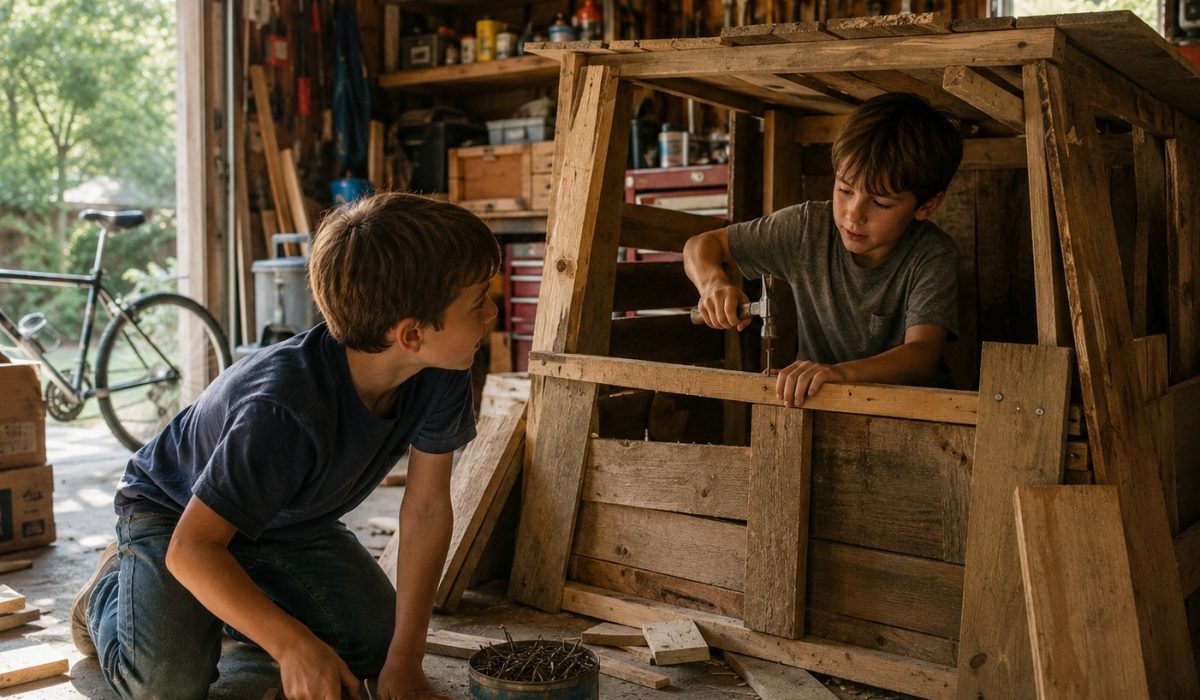
There was lumber everywhere if you knew where to look. Every week another house rose from the hillside, leaving behind short boards, crooked pieces, odd lengths of two-by-four, and scraps too small for carpenters to bother collecting. To builders they were leftovers. To the boys they were treasure.
One board became a wall.
Another leaned against it.
Soon there were three walls standing where none had existed before.
Nothing matched. Some boards were weathered gray while others were still pale from the sawmill. Nails bent as often as they drove straight. More than once they had to pry a board loose and begin again. They owned no blueprint and followed no plan beyond the conviction that each new piece somehow belonged.
The fort grew slowly, almost without either boy noticing.
Each afternoon another improvement suggested itself.
A stronger corner.
An opening that could serve as a doorway.
A wider platform.
The rafters overhead offered an irresistible possibility. By laying sturdy planks across them, they discovered they could create a second level above the first. It wasn't elegant. It probably wasn't particularly safe. It creaked whenever either boy crawled across it.
It was magnificent.
Sitting above the garage floor, surrounded by rough lumber that they had gathered and assembled themselves, they felt suspended in a world built entirely by their own hands.
No one else ever seemed interested in joining them.
That suited them perfectly.
The fort wasn't secret because it needed hiding. It was private because friendship itself is private. Some things lose their meaning when too many people enter them.
From the narrow spaces between the boards they watched bicycles roll past the driveway. They listened to neighborhood baseball games beginning in the street above. Sometimes they talked for an hour. Sometimes they said almost nothing at all. Silence comes easily to boys who are entirely comfortable with one another.
Outside, houses continued rising around them.
Inside the fort, time seemed to pause.
One afternoon curiosity got the better of them.
They wondered what the world looked like from inside their wooden walls. One of them found a long bit. Another found a brace. Before either fully considered the consequences, they bored a small hole through the garage wall and the stucco beyond.
A bright circle of California sunlight suddenly appeared.
One inch of daylight.
One inch of triumph.
They took turns peering through it, delighted by their tiny window onto the outside world.
It seemed harmless.
Children often mistake permanence for invisibility.
The hole did not remain undiscovered for long.
An adult eventually noticed the unexpected spot of light, and with that discovery the fort's future quietly came to an end.
No one raised their voice.
No great punishment followed.
The lumber simply disappeared over the next few days. Boards returned to scrap piles. Nails were pulled. The garage resumed being what garages were meant to be.
It happened so gradually that there was never a single moment when either boy realized the fort was gone forever.
Years later, he would forget hundreds of baseball games played in the street at the top of the hill. He would forget the names of children who came and went as new houses filled the subdivision. Entire summers would blur together until only fragments remained.
But he never forgot the fort.
Not because it had been well built. It hadn't.
Not because it had lasted. It didn't.
He remembered it because, for one remarkable season, two boys had gathered the discarded pieces of a growing neighborhood and built something no one else could have imagined. It wasn't really a fort. It was the first place they had ever created for themselves—a place where nothing needed to be explained, where status meant nothing, where fathers were simply fathers, and where friendship was measured one crooked board at a time.
He would spend much of the rest of his life building other things.
Different things.
But somewhere beneath every one of them remained the memory of two boys in a sunlit garage, discovering that the finest places in life are rarely purchased or inherited.
Sometimes they are built together from scraps that everyone else has overlooked.
Posted in focus-man by Geoff Stevens