
Focus Man: The Pool
Chapter 5
The pool lay at the end of a dirt road where the houses stopped.
That alone gave it a certain importance.
Beyond the last homes, the road narrowed and followed the edge of the oaks into land that had not yet been divided into lots and foundations and streets with curbs. In later years houses would spread into those open places as though they had always been intended to be there, but when Focus Man was ten there were still patches of Southern California that seemed to belong to nobody in particular.
The pool occupied one of them.
It was not a public swimming pool in the usual sense. It belonged to the neighborhood association, or perhaps to the development; Focus Man never knew precisely who owned it. Adults understood such arrangements. Boys understood that there was a pool at the end of the dirt road and that on hot summer afternoons water waited behind a chain-link fence.
The fence was tall.
At least it was tall when you were ten.
It surrounded both the pool and a small picnic area with tables beneath scattered trees. The gate was secured by a length of chain passed through the metal posts and fastened with a padlock. A sign listed the rules, including the one that mattered most to Focus Man and Tom.
Children were not permitted in the pool area without adult supervision.
They understood the rule.
They simply had difficulty seeing what it had to do with them.
On summer weekends adults came with towels and picnic baskets and children trailing behind them. The gate stood open then, and the pool became an ordinary place. Mothers sat in folding chairs. Fathers stood around picnic tables talking. Younger children splashed in the shallow end while older ones were repeatedly told not to run.
Focus Man and Tom preferred the pool at other times.
They would ride their bicycles down the dirt road and lean them somewhere among the trees before approaching the fence.
There was always a moment of inspection.
The chain was the first thing to check.
Whoever locked the gate usually wrapped it several times around the gatepost before snapping the padlock closed. When it was done properly, the gate barely moved.
But adults were inconsistent.
Sometimes the chain had been left loose enough that the gate would open several inches.
Several inches could be enough.
Tom would pull the gate outward while Focus Man turned sideways and tried to pass through the opening. The chain tightened against the posts. The metal gate pressed against his back. For a moment he would be suspended between success and the possibility of remaining permanently wedged in the entrance to a swimming pool he wasn't supposed to be entering.
"You're stuck," Tom might say.
"I'm not stuck."
"You look stuck."
"Pull harder."
Tom would pull.
Focus Man would exhale, flatten himself as much as a skinny ten-year-old boy could flatten himself, and suddenly pop through to the other side.
Then came Tom.
This presented a problem because Tom was bigger.
Focus Man would take the gate from inside and pull while Tom squeezed through from the road. There was pushing and grunting and whispered accusations that the other boy wasn't pulling hard enough.
Eventually both were inside.
Other times the chain was too tight.
That required a different engineering solution.
The fence itself was chain link, and along portions of the bottom there was enough give that one boy could pull the wire outward while the other flattened himself against the ground and crawled beneath it.
This was less elegant.
It involved dirt.
There were also burrs, dry leaves and occasional uncertainties concerning spiders.
But it worked.
Tom usually held the fence first.
Focus Man would lie on his stomach and push his arms through the opening. Tom pulled upward with both hands while Focus Man wriggled beneath.
"More."
"I'm holding it."
"It's on my back."
"Then move."
"I'm trying to move."
"You're not moving."
Eventually Focus Man emerged on the other side with dirt on his shirt and pieces of dry grass in his hair.
Then he held the fence for Tom.
Tom was harder to fit.
This gave Focus Man a certain satisfaction.
The fence was too tall and too unstable to climb safely. They had considered it. Boys considered most things. But climbing chain link that high meant the fence bowed toward you as you climbed, and getting over the top involved considerably more courage than either wished to admit he lacked.
Going under seemed sensible.
They never thought of themselves as trespassing.
Trespassing was something criminals did.
They were going swimming.
Once inside, the illicit nature of the expedition largely disappeared. Towels went onto a picnic table. Shoes came off. They ran across the warm concrete and jumped in.
The first plunge was always worth whatever indignities the fence had required.
On hot afternoons the water felt impossibly cold for the first few seconds. Focus Man would come to the surface gasping, wipe his hair from his eyes, and immediately dive under again.
The pool changed him.
On land, Tom was better at nearly everything physical.
He ran faster. He was stronger. In football he could get farther down Eilinita before Focus Man's pass arrived. If they raced bicycles uphill, Tom usually won. He seemed to possess the kind of body that simply understood what boys wanted bodies to do.
Focus Man was used to this.
Mostly.
But in the water things changed.
Focus Man could swim.
Not merely stay afloat or make his way from one side of the pool to the other. He understood the water in a way he didn't understand running. His body stretched naturally into it. His kick found a rhythm. His arms entered cleanly, and when he turned his head to breathe he didn't have to think about what came next.
Tom was a good swimmer too.
Focus Man was better.
This mattered.
Neither boy would have said so directly because boys have elaborate ways of knowing exactly where they stand without discussing it. Tom knew he was faster on the street. Focus Man knew he was faster in the pool.
The universe was properly balanced.
Their unauthorized swimming sessions continued through the summer.
Sometimes they had the entire place to themselves for what seemed like hours. Oak trees stood beyond the fence. Birds moved through the branches. A car might pass somewhere in the distance, but nobody came down the dirt road.
They raced.
They dove for objects tossed into the deep end.
They invented competitions whose rules changed according to whichever boy was losing.
When they finally decided to leave, they dried themselves as well as two impatient boys ever dried themselves, forced their way back beneath the fence or through the gate, retrieved their bicycles, and rode home.
Nobody caught them.
This astonished Focus Man more in retrospect than it did at the time.
At ten, the absence of adults did not seem unusual. Adults existed when required. They made dinner, drove cars, enforced bedtimes, supplied money for movies, and occasionally established unreasonable rules about swimming pools.
The rest of the world belonged largely to boys.
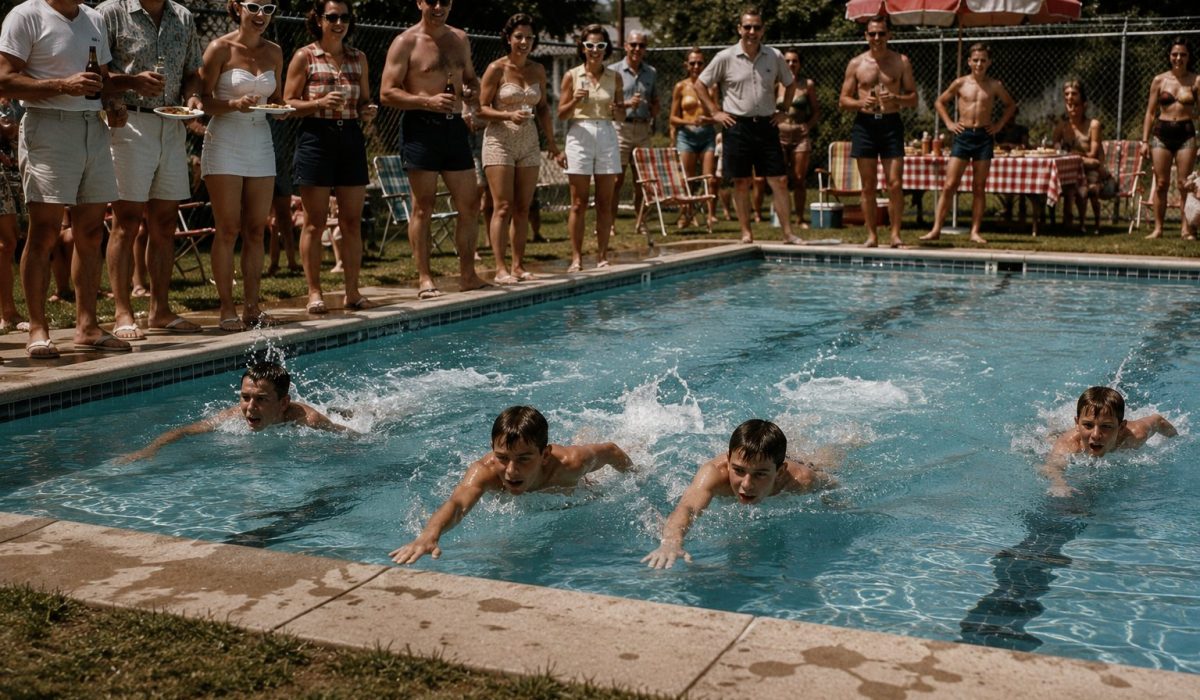
Then came the Fourth of July.
The pool was transformed.
Families filled the picnic area. Folding chairs appeared along the fence. Coolers sat beneath tables covered with food. Someone had decorated the gate. Children who ordinarily arrived in small groups seemed to have multiplied overnight.
There were games.
There were races.
Focus Man was interested in the races.
This was his territory.
The age groups were announced, and eventually he and Tom stood together at one end of the pool with several other boys.
Focus Man looked down the lane.
He wasn't nervous.
Why would he be?
Tom was faster at almost everything else.
This was swimming.
Someone explained the rules. There wasn't much to explain. They would race to the other end. First one there won.
Focus Man crouched near the edge.
Someone shouted for them to go.
They dove.
For the first few strokes Focus Man saw nothing except bubbles and the wavering blue line beneath him. He surfaced into his rhythm and began pulling hard.
He could hear splashing on either side.
He didn't know where Tom was.
Halfway across, Focus Man felt good.
This was the familiar part—the long reach, the pull, the kick behind it. He increased his effort.
The wall approached.
Then, at the edge of his vision, someone was beside him.
Tom.
Focus Man pulled harder.
So did Tom.
For several strokes they were nearly even.
Focus Man reached for the wall.
Tom touched first.
There could not have been much between them.
An arm.
Perhaps less.
It was enough.
Tom came up grinning.
"I beat you."
Focus Man held the edge of the pool and wiped water from his face.
"You got a better start."
Tom's grin widened.
"I beat you."
"I slipped."
"You didn't slip."
"I didn't get a good push."
"You said you weren't worried about the start."
Focus Man had apparently said several things before the race that now seemed poorly considered.
Adults were congratulating them. Someone announced the winner.
Tom.
Focus Man climbed from the pool.
He was not devastated.
This distinction should be made.
He was ten years old, it was the Fourth of July, there was food on the picnic tables, and they would probably be back in the water within minutes.
But he was annoyed.
Deeply, specifically annoyed.
Tom could have running.
Tom could have football.
Tom could have bicycles and anything requiring upper-body strength.
Swimming belonged to Focus Man.
Apparently Tom had not understood the arrangement.
For the rest of the afternoon, Tom mentioned his victory only when circumstances made it necessary.
Circumstances made it necessary quite often.
"Want to race again?"
"No."
"Afraid I'll beat you?"
"You won once."
"Today."
"Once."
"On the Fourth of July."
Focus Man walked away.
Tom followed him.
"I think that makes me the champion."
"There is no champion."
"They gave me a ribbon."
"It was one race."
Tom examined the ribbon.
"It says first place."
Focus Man disliked documentary evidence.
By the time they rode home, the matter had mostly been forgotten.
Mostly.
Years later, Focus Man could remember remarkably little about that Fourth of July. He didn't remember what they ate or which families were there. He couldn't remember whether there had been fireworks that night or whether his parents had taken him somewhere else to watch them.
He remembered Tom touching the wall first.
Some defeats apparently possessed superior archival qualities.
But when he thought about the pool, that race was only part of what returned.
He remembered the dirt road.
The oaks.
The bicycles left outside the fence.
He remembered Tom pulling the chain-link upward while he crawled through the dust beneath it, both of them completely confident that whatever rule they were violating had been written for some other kind of child.
He remembered entire afternoons when the pool belonged to them.
And he remembered the peculiar arithmetic of childhood friendship, in which one boy could be faster and stronger at nearly everything and the other could still possess one small territory that was unquestionably his.
Until the Fourth of July.
Tom had taken that too.
Focus Man smiled whenever he remembered it.
He still thought he had gotten a bad start.
Posted in focus-man by Geoff Stevens