Collecting Breeds
Many people begin their chicken-keeping journey with a simple plan.
A small flock.
A few fresh eggs.
A modest coop in the backyard.
Then something unexpected happens.
They discover there isn't just one kind of chicken.
There are hundreds.
And before long, many chicken owners find themselves becoming collectors.
It Starts with One Breed
The first flock is often selected for practical reasons.
Perhaps Rhode Island Reds for reliable egg production.
Or Buff Orpingtons for their friendly personalities.
Maybe Australorps because a neighbor recommended them.
At first, the goal is simply to keep chickens.
But once owners begin learning about different breeds, curiosity takes over.
Discovering the Variety
A visit to a poultry show, farm store, or chicken website quickly reveals an astonishing range of possibilities.
There are:
-
Giant Brahmas
-
Fluffy Silkies
-
Colorful Easter Eggers
-
Elegant Wyandottes
-
Tiny Bantams
-
Historic heritage breeds
Suddenly, one flock no longer seems like enough.
Many hobbyists begin thinking:
"Maybe I should add just one more breed."
The "Just One More" Syndrome
Chicken enthusiasts often joke about a condition known as "Chicken Math."
It works something like this:
You planned for six hens.
Then you discover Silkies.
A few months later, a pair of Brahmas seems like a good idea.
Then someone offers a rare heritage breed.
Before long, the flock has grown far beyond its original size.
Most collectors laugh because they've experienced exactly the same thing.
Every Breed Has a Story
Part of the attraction is that each breed brings something unique.
Some are known for:
-
Exceptional egg production
-
Beautiful feather patterns
-
Gentle personalities
-
Historic significance
-
Rare genetics
-
Exhibition potential
Collectors enjoy learning the histories and characteristics that make each breed special.
The flock becomes a living collection of stories as well as birds.
A More Colorful Coop
Mixed-breed flocks are often visually stunning.
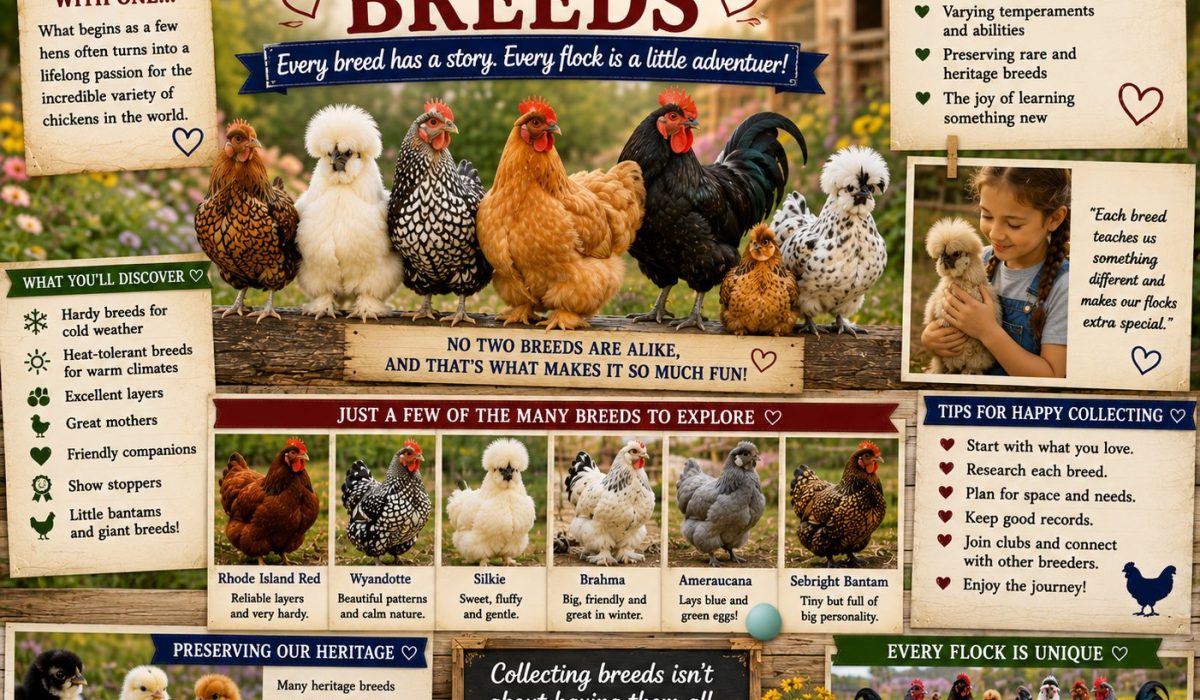
A collector's coop might include:
-
A silver-laced Wyandotte
-
A white Silkie
-
A red Rhode Island Red
-
A blue Ameraucana
-
A feather-footed Brahma
The result is a flock filled with different colors, shapes, sizes, and personalities.
No two birds are exactly alike.
Learning Through Experience
Collecting breeds teaches owners a great deal about chickens.
They quickly discover:
-
Which breeds are friendliest
-
Which tolerate cold weather best
-
Which are strongest foragers
-
Which lay the most eggs
-
Which make the best mothers
Every new breed adds another chapter to the learning experience.
The Search for Something Rare
For some hobbyists, the fun lies in finding uncommon breeds.
They attend:
-
Poultry shows
-
Breed club events
-
Hatchery open houses
-
Swap meets
The search itself becomes part of the hobby.
Finding a rare bird can feel a bit like discovering a hidden treasure.
More Than a Collection
Unlike stamps, coins, or antiques, a chicken collection is alive.
The birds interact.
They grow.
They hatch chicks.
They develop personalities.
Every day brings something new to observe and enjoy.
That makes collecting breeds a uniquely rewarding hobby.
There's Always One More Breed
Ask experienced poultry collectors how many breeds they own, and many will smile before answering.
Then ask if they are finished adding new breeds.
The answer is usually another smile.
Because somewhere out there is a breed they haven't raised yet.
A breed with an interesting history.
A beautiful feather pattern.
A unique personality.
For many chicken enthusiasts, collecting breeds isn't about owning every chicken in the world.
It's about appreciating the incredible variety that exists within the chicken world and enjoying the journey of discovering one remarkable breed at a time.
Posted in raising-chickens by Erik Johansson