
Focus Man: The Night Everything Changed
Chapter 7
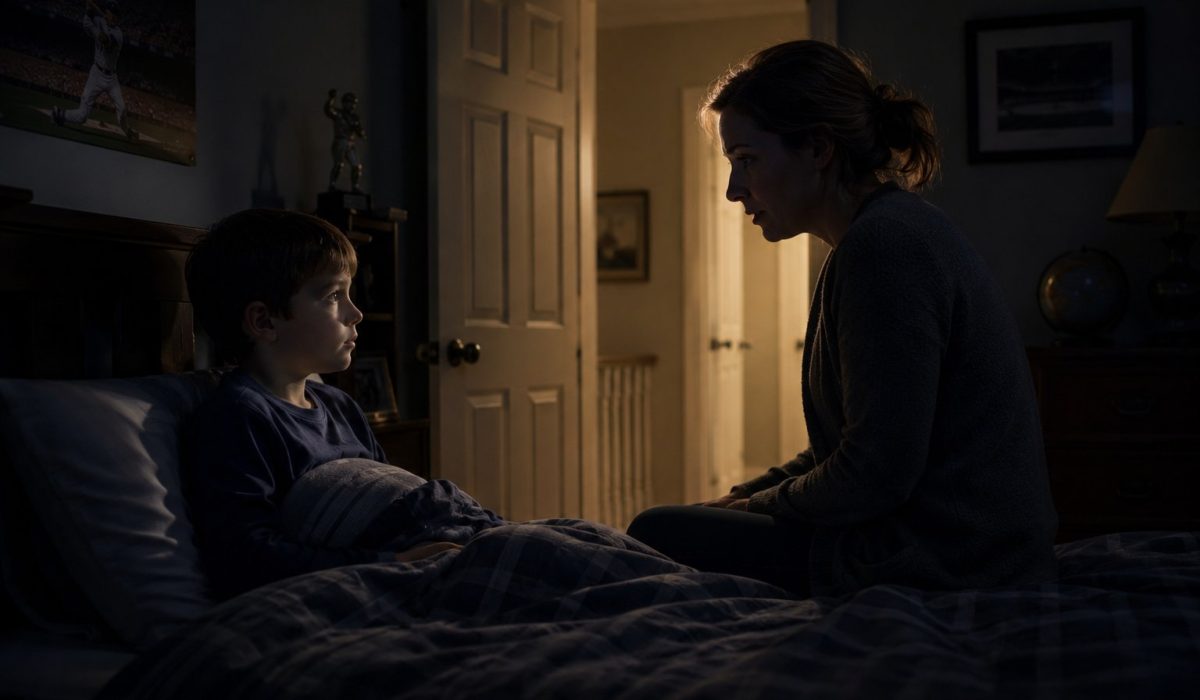
The house was quiet when his mother opened the bedroom door.
That was one of the details he kept.
There would be other memories from that time that gradually became uncertain—things he could no longer tell whether he actually remembered or had reconstructed from photographs, family stories, and all the years of knowing what had happened. But the door opening remained. So did the hallway light behind his mother and the sense, before she had spoken a word, that she had entered his room for a reason unlike any other.
He had been asleep. He did not remember dreaming or hearing anything beforehand. One moment there had been the ordinary unconsciousness of a boy asleep in his own bed, secure in the unexamined assumption that morning would resemble the day before it. Then his mother was standing in the doorway.
He sat up.
The hallway light left part of her face in shadow. She didn't come immediately to the bed. For a moment she remained near the door, and even as a boy he could see that she was trying to do something difficult. Adults usually entered children's rooms knowing what they intended to say. Turn the music down. It's time to get up. You're going to be late. Your friend is on the telephone.
His mother seemed to have no words ready.
Then she came into the room.
"Your father died tonight."
There are sentences so large that the mind seems to make them smaller in order to receive them.
He knew what every word meant. There was no unfamiliar language to puzzle over, nothing requiring explanation. His father had died. Yet understanding the sentence and understanding what had happened were entirely different things.
He looked at his mother and waited.
That was what he remembered doing.
Waiting.
Perhaps there would be another sentence. His father had died, but something else was also true. There had been a mistake. Someone had misunderstood. The doctors had done something. His mother would add the missing piece that allowed the first sentence to fit back inside the world he already knew.
Nothing she could have said would have done that.
She sat beside him on the bed and put her arm around him. He did not cry. That would come later, when grief had acquired enough shape for tears. At that moment there was mostly bewilderment, and beneath it something almost like disbelief—not the belief that his mother was wrong, but the inability to understand how a fact so enormous could have entered such an ordinary room.
Nothing in the room had changed.
The dresser was where it had always been. His clothes were where he had left them. The curtains moved slightly in the air from the open window. Whatever objects a boy had accumulated on shelves and tabletops remained exactly where they had been when he went to sleep.
His father was dead.
The room seemed unaware of it.
His mother stayed with him for a while. He could no longer remember what else she said, if anything. Perhaps she explained where his father had been or what had happened. Perhaps she told him something about the hours ahead. Those words were lost.
He remembered her arm around him.
Then, eventually, she left.
The door did not close completely behind her, and a narrow strip of hallway light remained on the floor.
He lay back down.
Sleep did not return.
The house had sounds at night that he had never considered worth listening to before. The refrigerator came on in the kitchen and ran for a while before stopping. Somewhere outside, a car passed along the street. A dog barked in the distance, waited as though expecting an answer, then barked again.
He heard the house settle.
He heard plumbing.
He heard movement somewhere beyond his bedroom and wondered whether it was his mother.
Ordinary sounds became strangely distinct when there was nothing else to do but wait for them.
And among those sounds he listened for his father.
He did not consciously expect him to come home. His mother had been clear. But the body has habits the mind does not immediately know how to abandon. There were footsteps he knew. The sound of a door. A voice elsewhere in the house. The small noises by which another person's presence becomes part of a place.
He listened for one of them.
Nothing came.
Years later, it was this that seemed closest to his first understanding of death. Not the sentence his mother had spoken, although he never forgot it. Not a funeral or the people who would soon fill the house.
It was the missing sound.
His father had occupied a place in the ordinary noise of the world, and suddenly that place was silent.
Morning eventually found him.
He did not remember whether he slept at all before daylight appeared at the window. He remembered that the house no longer seemed like the same house, though nothing visible had changed. Adults began arriving. Relatives came. Neighbors. People he knew well and others he knew only because his parents knew them.
They entered differently than visitors ordinarily entered.
Voices were lower. People touched his mother's arm when they spoke to her. There were embraces that lasted longer than usual. Coffee appeared. Someone brought food, because food was apparently something adults brought when there was nothing useful they could do.
Focus Man watched.
He had always watched people, though he would not have described it that way then. Now he watched with greater attention because everyone around him seemed to understand something he did not.
Conversations changed when he entered the room.
Not always. And perhaps not intentionally. But he noticed unfinished sentences. He noticed adults looking at one another before answering questions. He noticed the peculiar language people used around death, as though the plain words were too sharp to be handled repeatedly.
There were things he wanted to know and things he did not know enough to ask.
Mostly he listened.
His father's death had created a hole in the family, but a boy could not yet see the shape of it. He could see only the immediate absence. A chair. A voice. Someone who should have been in the house and wasn't.
The larger consequences would reveal themselves slowly.
There would be decisions made by adults. Changes he would understand only after they had happened. His mother would have a life to rebuild while carrying grief of her own. The boy would continue growing because children do, even when the structure around them has changed without their permission.
But none of that belonged to that first morning.
That morning there were simply too many people in the house and one person missing.
For a long time afterward, Focus Man would return in memory to the night his mother opened the bedroom door. As he grew older, he sometimes tried to understand whether that was the moment something fundamental in him changed.
He distrusted explanations that came too neatly.
It would be easy, looking backward, to say that this was where he became observant, where he learned to listen beneath what people said, where his need to understand the world began. Lives seldom arranged themselves so conveniently. The boy who had raced Tom in the pool and explored the hills and studied how things worked had already been himself long before his father died.
But something had been added.
He had learned that the familiar was not permanent.
A person could be there when you went to bed and gone before you woke. A family could change while a boy slept. A house could contain the same furniture, the same curtains, the same refrigerator humming in the kitchen, and yet become a different place entirely.
He did not have words for any of this then.
He was only a boy lying awake in the dark.
There would be tears later.
That night he listened.
Posted in focus-man by Geoff Stevens